

Why Rising DRAM and SSD Prices Are Changing Infrastructure Strategy - And Why Retrofit Hardware Support Makes Sense

Let’s talk retrofit hardware support.
Over the past year, one topic keeps surfacing in conversations with IT leaders: pricing.
DRAM and SSD costs are climbing again, and unlike previous short-term fluctuations, this shift is landing at a time when many organisations are already under pressure to do more with tighter budgets. Hardware refresh cycles that once felt routine are suddenly becoming strategic financial decisions.
For many teams, the question is no longer “When do we upgrade?”
It’s becoming “Do we need to upgrade right now?”
The Hidden Cost of Automatic Refresh Cycles

For years, infrastructure planning followed a predictable rhythm. Warranty expires, hardware gets replaced. It was a clean, safe model and in a stable pricing environment, it makes sense.
But automatic refresh cycles assume one thing: that the market is stable.
Today, it isn’t.
Refreshing infrastructure during peak component pricing can compress budgets, pull forward capital expenditure, and reduce flexibility for future investment. And in many cases, it forces organisations to replace systems that are still performing perfectly well.
Stable Hardware Doesn’t Become Unreliable Overnight
One of the biggest misconceptions in enterprise IT is that out-of-warranty hardware automatically becomes high risk.
In reality, hardware reliability doesn’t suddenly expire with a manufacturer contract. Systems that are stable, monitored, and properly maintained can continue to operate safely well beyond their original warranty window.
When hardware is backed by specialist retrofit service plans, organisations gain continued protection, predictable support, and access to replacement parts, without being forced into premature capital refreshes.
Retrofit Support: Extending Lifecycle Without Extending Risk
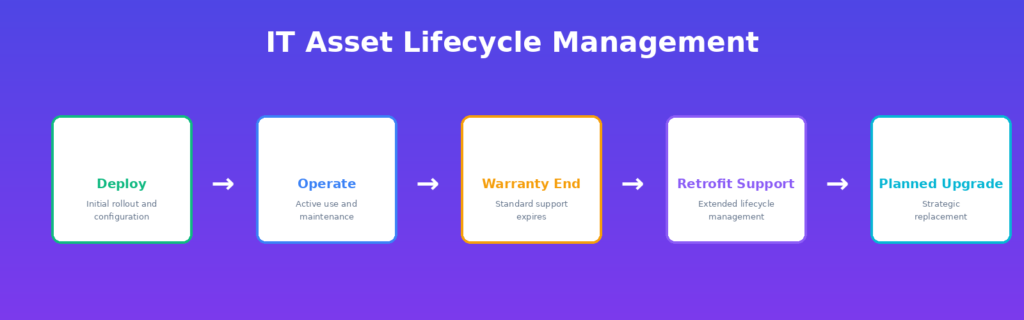
Retrofit service plans are often misunderstood as a temporary workaround. In practice, they’re a strategic lifecycle tool.
They allow organisations to:
Extend the usable life of stable infrastructure
Avoid refresh cycles driven purely by warranty deadlines
Stabilise operational budgets during volatile pricing periods
Upgrade based on business need rather than market pressure
This approach gives IT leaders breathing room. Instead of reacting to pricing spikes, teams can plan upgrades deliberately, aligning investments with long-term strategy rather than short-term fear.
In today’s environment, that flexibility is a competitive advantage.
Get In Touch Today For A Servernation Retrofit Support Package
If you’re reviewing infrastructure budgets or facing upcoming warranty expirations, now is the time to reassess lifecycle strategy.
Retrofit support isn’t about postponing upgrades indefinitely, it’s about upgrading on your terms.
Servernation helps organisations protect uptime, extend hardware value, and avoid forced refresh cycles during volatile pricing periods.